

Skimming vs Plastering: What’s the Difference?
More advice
If you are renovating a room, the words skimming and plastering are often used as though they mean exactly the same thing. They are closely related, but in practice they can describe quite different amounts of work.
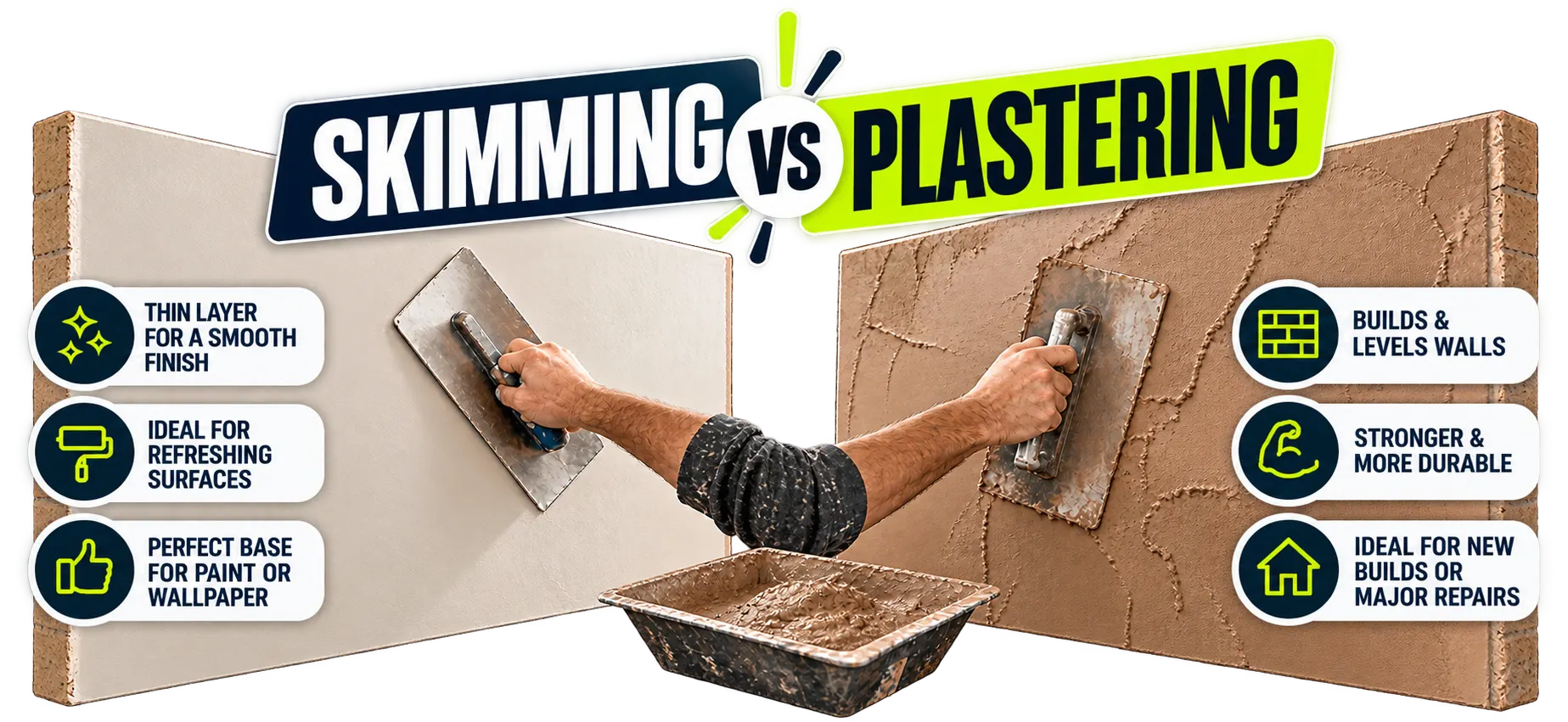
Skimming is the final thin finishing coat applied over a suitable background. Plastering is the broader process and can include repairs, preparation, boarding, backing coats and the final skim.
That distinction matters when you are comparing quotes. One room may only need a fresh finishing coat, while another may need work to the underlying walls before a good finish can be achieved.
What does skimming involve?
Skimming is used when the background is already suitable and the main objective is to create a smooth, consistent surface.
The existing wall might be sound but tired, uneven from years of decorating or recently repaired. New plasterboard can also be finished with a skim once its joints, fixings and corners have been properly prepared.
The important point is that skimming is a finishing process. It is not intended to make loose plaster sound again or correct every problem hidden beneath the surface.
Learn more about our Skimming service →
What does “plastering” include?
Plastering can mean much more than the final coat. On an older or damaged wall, the job may begin with removing loose material, repairing cracks, replacing plasterboard or rebuilding sections that are no longer suitable.
Only after the background is stable and properly prepared does the finishing stage make sense.
That is why a contractor may describe a project as “plastering a room” even though some walls only need skimming and others require more substantial work.
When is a skim usually enough?
A skim may be appropriate where the wall is fundamentally sound and the problem is mainly the quality of the visible surface.
Examples include a room with old decorating marks, minor surface imperfections or a properly prepared wall that simply needs one consistent finish before painting.
The plasterer still needs to check adhesion and preparation. Painted surfaces, previous repairs and differences between backgrounds can all affect how the new plaster should be applied.
When is more extensive plastering needed?
If the wall contains loose, hollow or badly damaged sections, applying a new skim over the top can hide the problem without solving it.
More extensive work may be needed where there are large failed areas, damaged plasterboard, deep cracks, poor previous repairs or backgrounds that are not suitable for a finishing coat.
The correct response depends on the cause and extent of the problem. In some cases a local repair is enough; in others, larger areas need to be taken back and rebuilt.
See our Plaster Repairs service →
What about ceilings?
The same distinction applies to ceilings. A stable ceiling may only need skimming, while a damaged or uneven one may need repairs or overboarding before it is finished.
Older textured ceilings also need extra care. Some textured decorative coatings can contain asbestos, so their age and condition should be considered before any work that could disturb them.
Read: Can You Plaster Over Artex or Textured Ceilings? →
Which is cheaper?
A simple skim is usually less involved than removing failed plaster or rebuilding parts of a wall, so it will often cost less. But the price still depends on room size, preparation, access and whether ceilings are included.
The more useful question is therefore “What does this surface need?” rather than “Which service has the lower starting price?”
A quote that includes the right preparation can be better value than a cheaper one that assumes every background is ready to skim.
Read: How Much Does It Cost to Plaster a Room? →
How do you know which option your room needs?
The decision usually comes from inspecting the condition of the walls and ceilings.
A plasterer will look at how well the existing plaster is bonded, whether cracks are stable, whether previous repairs are sound and what surface the new plaster will actually be applied to.
This is particularly important in older homes where a room may contain several different backgrounds from previous alterations.
What finish should you expect?
Whether the job is a straightforward skim or a more extensive plastering project, the final objective is a consistent surface suitable for decorating once it has fully dried.
Good plastering is not only about what the wall looks like while the plaster is still wet. The preparation, transitions between surfaces and final finish all affect how the room will look once painted.
Read: How Long Does Plaster Take to Dry Before Painting? →
How M&M would approach it
At M&M Coloured Rendering & Plastering, we would assess the existing surfaces first and then explain whether a skim is enough or whether repairs and preparation are needed before the finishing coat.
That keeps the specification matched to the room rather than treating every wall as the same job.
Quick answer: skimming is the thin finishing coat used over a suitable surface. Plastering is the wider process and can include repairs, preparation, boarding and finishing. If your walls are sound but uneven, a skim may be enough; if the background is damaged or unstable, more work may be needed first.
Related articles
Ready to get started?
Send us a few details and we'll get back to you with a free, no-obligation quote.
 Call
 WhatsApp
 Free Quote