

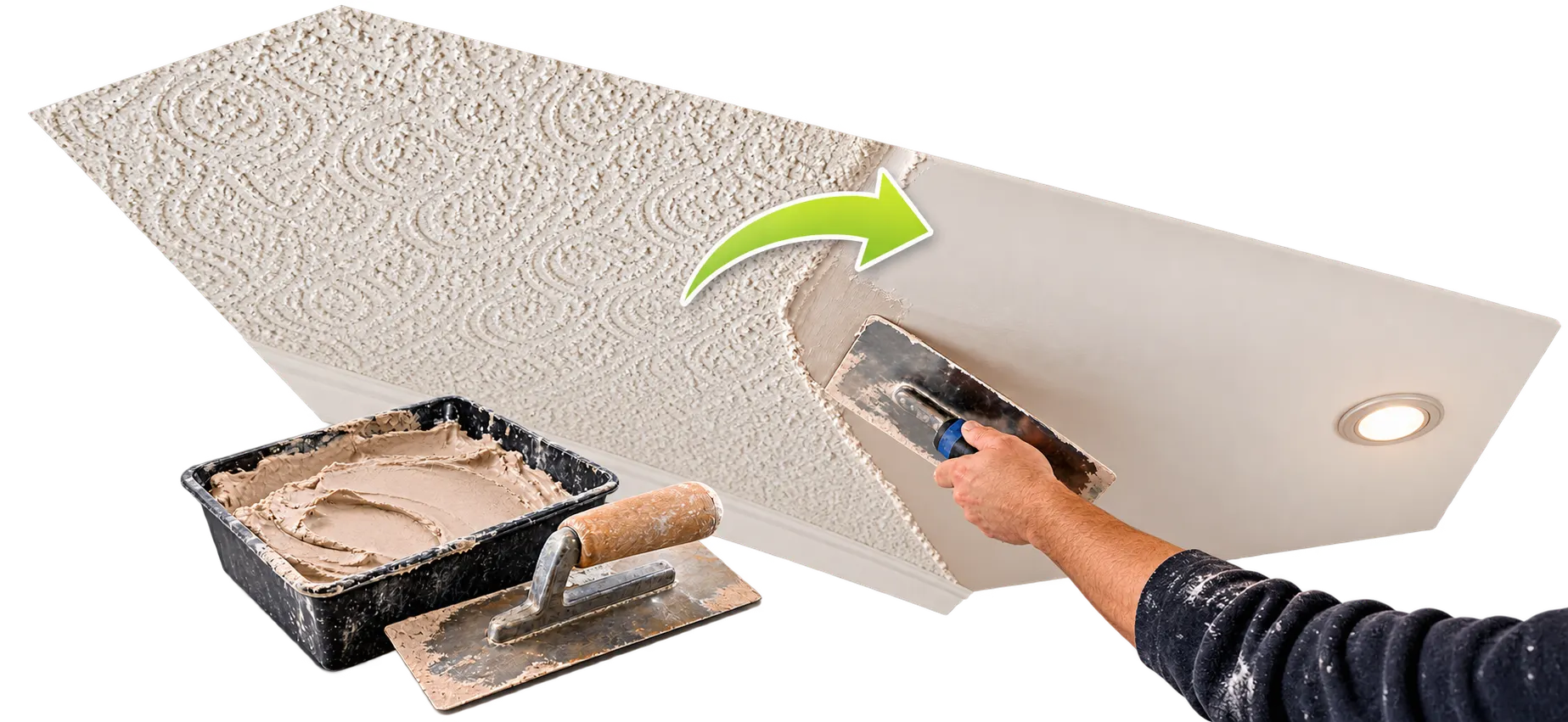
Can You Plaster Over Artex or Textured Ceilings?
More advice
Many UK homes still have swirled, stippled or patterned ceilings, and homeowners often want to replace that texture with a clean, smooth finish.
In some situations a textured ceiling can be prepared and skimmed. In others, overboarding or more extensive repair work may be the better approach.
The decision depends on the condition of the existing surface, how deep the texture is, how securely it is bonded and whether the coating could contain asbestos.
What do people mean by “Artex”?
Artex is a trade name that became widely associated with decorative textured coatings used on walls and ceilings.
Homeowners now often use the word “Artex” to describe almost any patterned ceiling, even where a different product was originally used.
That distinction matters because you cannot reliably identify the exact material, or whether it contains asbestos, simply by looking at the pattern.
Can a textured ceiling be skimmed?
Potentially, yes. If the coating and the ceiling beneath it are suitable, stable and correctly prepared, plastering can be used to create a smooth finish.
However, a plasterer should not treat every textured ceiling as automatically ready for a skim. Loose coatings, water damage, movement cracks or a weak background can all change the right approach.
The objective is to create a sound surface that the new plaster can bond to, not simply cover the visible pattern.
When might overboarding be a better option?
Overboarding means fixing new plasterboard beneath the existing ceiling and then finishing the new boards.
It can be considered where the existing surface is very uneven, the texture is particularly deep or the ceiling needs a new consistent background before it is skimmed.
It is not automatically better than direct skimming, and it still requires the existing ceiling structure to be suitable for the proposed work.
The choice should be based on the actual ceiling rather than a blanket rule.
See our Ceiling Plastering service →
The asbestos question should come before preparation
The Health and Safety Executive lists textured decorative coatings, including products historically sold under names such as Artex, among materials that can contain asbestos.
That does not mean every textured ceiling contains asbestos. It does mean older coatings should be considered carefully before work that may disturb them.
If there is reason to suspect an asbestos-containing material, the appropriate assessment should take place before drilling, sanding, scraping or removal.
Homeowners should not rely on appearance alone to decide that a coating is asbestos-free.
Why “just scrape it flat” is not good general advice
Scraping and sanding disturb the existing material. That can be inappropriate if the coating is unstable, and it is particularly important to avoid casual disturbance where asbestos has not been ruled out.
The preparation method should suit the actual coating, background and plaster system being used.
A professional assessment can therefore save unnecessary work as well as reduce the risk of choosing the wrong method.
What if the ceiling is cracked or damaged?
Cracks need to be considered separately from the texture itself.
A small, stable defect may be dealt with during preparation, while widespread movement, failed plaster or water damage may require more substantial repair work.
Simply smoothing over a ceiling that is loose underneath is unlikely to produce a durable result.
See our Plaster Repairs service →
How much does smoothing a textured ceiling cost?
The price depends on ceiling size, height, access, the depth and condition of the texture and whether the surface can be skimmed directly or needs additional work.
That is why a fixed “price to cover Artex” can be misleading. One ceiling may need straightforward preparation and plastering, while another may need boarding, repairs or specialist assessment first.
Read: How Much Does It Cost to Plaster a Room? →
What finish should you expect?
Once the correct preparation has been completed, the aim is a smooth, consistent ceiling suitable for decorating after it has fully dried.
Ceilings show defects easily because light travels across them, so good preparation and careful finishing make a noticeable difference once the room is painted.
Read: How Long Does Plaster Take to Dry Before Painting? →
How M&M would approach the job
At M&M Coloured Rendering & Plastering, we would first look at the condition of the ceiling and discuss the most appropriate plastering approach.
Where the age or nature of the coating raises an asbestos concern, that question should be resolved before any work that could disturb the material begins.
Quick answer: some textured ceilings can be prepared and skimmed, while others may be better overboarded or repaired first. Older textured coatings can contain asbestos, so the coating and its condition should be appropriately assessed before it is disturbed.
Related articles
Ready to get started?
Send us a few details and we'll get back to you with a free, no-obligation quote.
 Call
 WhatsApp
 Free Quote