

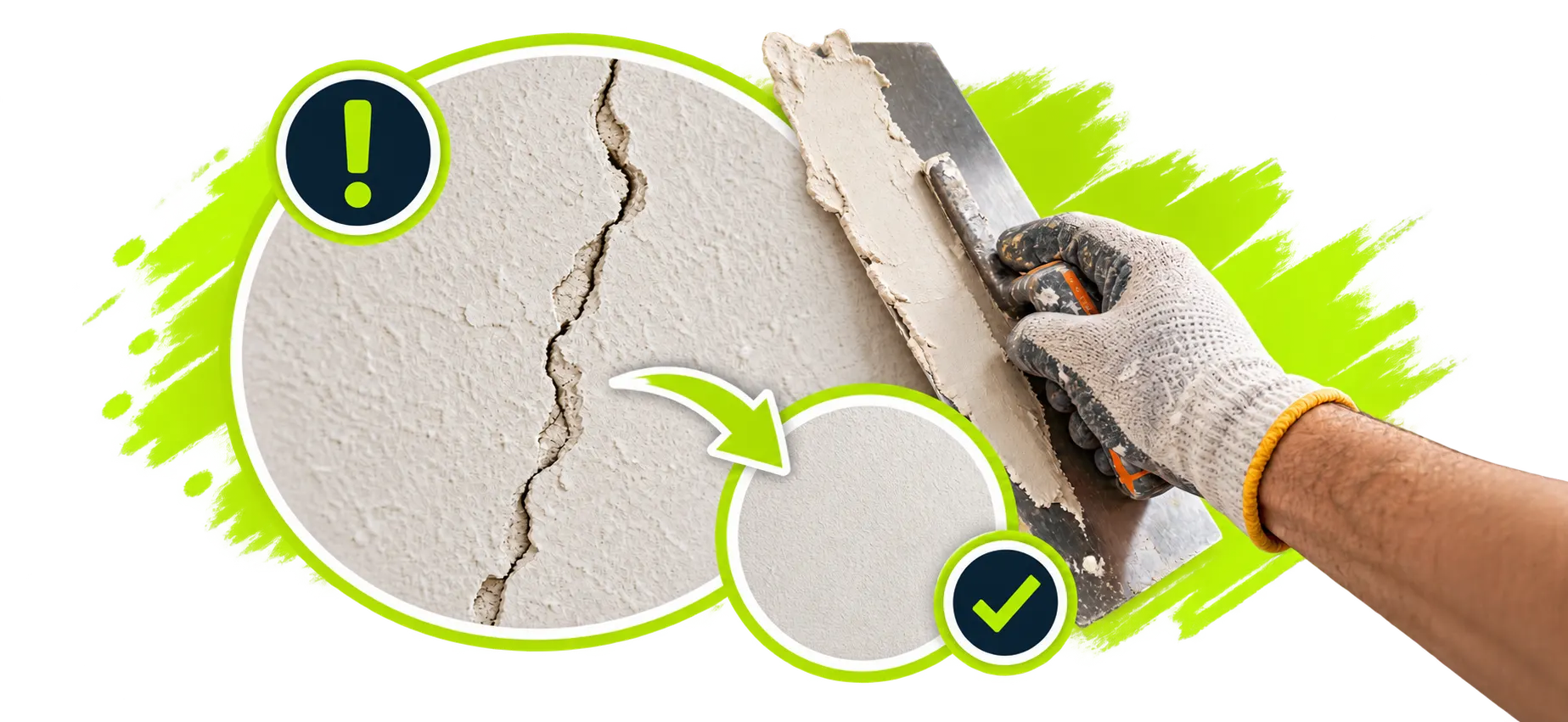
Why Does Plaster Crack and When Should You Worry?
More advice
A crack in a freshly decorated wall can be alarming, but not every plaster crack means there is a serious structural problem.
Plaster is a relatively rigid finish applied over backgrounds that can move, dry and respond to temperature changes. Fine cracks can therefore appear for several reasons, ranging from normal shrinkage to movement at joints between different materials.
The useful question is not simply “is there a crack?” but where is it, how wide is it, and is it changing?
Hairline cracks are often cosmetic
Very fine cracks can develop as plaster or surrounding materials dry and settle.
They are particularly common around joints, repaired areas and changes between backgrounds. A small stable hairline crack is very different from a crack that keeps widening or returns repeatedly after repair.
If the surrounding plaster is otherwise sound, a local repair may be all that is needed.
Movement between different materials is a common cause
Modern rooms often contain a mixture of masonry, plasterboard, old plaster and newer repairs.
Those materials do not always move in exactly the same way. Joints around extensions, blocked openings, boards and repaired areas can therefore become visible through the finished plaster.
Correct preparation helps manage these transitions, but it cannot make a moving building completely rigid.
Loose or failed plaster can crack repeatedly
Older plaster can lose its bond to the background.
If the material behind the visible finish is loose or hollow, filling the surface crack alone may only provide a temporary cosmetic improvement.
This is why a plasterer may recommend removing and repairing a failed area rather than repeatedly applying filler to the same line.
See our Plaster Repairs service →
Why can new plaster crack?
Cracking in new plaster can be caused by movement in the background, shrinkage, a joint beneath the finish or an existing defect transferring through.
The pattern and timing matter. One isolated fine crack is different from widespread cracking or movement accompanied by other changes in the room.
If the plastering has only recently been completed, contact the contractor before carrying out extensive repairs yourself. It is easier to assess the original finish before it has been repeatedly filled and painted.
Can skimming hide a crack?
A skim creates a smooth surface, but it is not a structural repair.
If the background is unstable or a crack is actively moving, simply covering it with new plaster may hide the line for a while without addressing the cause.
Preparation should deal with the condition of the surface first. Where movement is significant, further investigation may be needed before cosmetic plastering is carried out.
Read: Skimming vs Plastering →
When should you take a crack more seriously?
A plasterer can assess the plaster finish, but some signs point beyond the plaster itself.
Cracks that are clearly widening, repeatedly returning, associated with significant distortion or accompanied by doors and windows suddenly sticking may justify further investigation.
The same applies where cracking is connected with a known leak, major building movement or damage that appears suddenly across several areas.
A blog article cannot diagnose structural movement from a photograph. Where the concern is the building rather than the plaster finish, an appropriately qualified building professional may be required.
What is the right way to repair cracked plaster?
The repair method should match the defect.
A stable cosmetic crack may need local preparation and filling. A failed plaster area may need to be cut back to sound material and rebuilt. A crack at a joint may need different treatment again.
The important part is understanding what you are repairing before hiding the visible line.
How do exterior render cracks differ?
Exterior render is exposed to weather, temperature changes and moisture, so its cracking mechanisms are not identical to internal plaster.
We cover that separately in Why Does Exterior Render Crack? so homeowners can distinguish between an internal finishing problem and an external wall-system issue.
How M&M would assess it
At M&M Coloured Rendering & Plastering, we would look at the crack pattern, the condition of the surrounding plaster and the background before recommending a repair.
Where the signs suggest something beyond the plaster finish, we would not treat a cosmetic skim as a substitute for investigating the underlying issue.
Quick answer: plaster cracks can be caused by drying, small amounts of movement, joints between materials, loose existing plaster or previous repairs. Fine stable cracks are often cosmetic, but cracks that widen, repeatedly return or appear with other signs of movement should be investigated rather than simply covered.
Related articles
Ready to get started?
Send us a few details and we'll get back to you with a free, no-obligation quote.
 Call
 WhatsApp
 Free Quote