

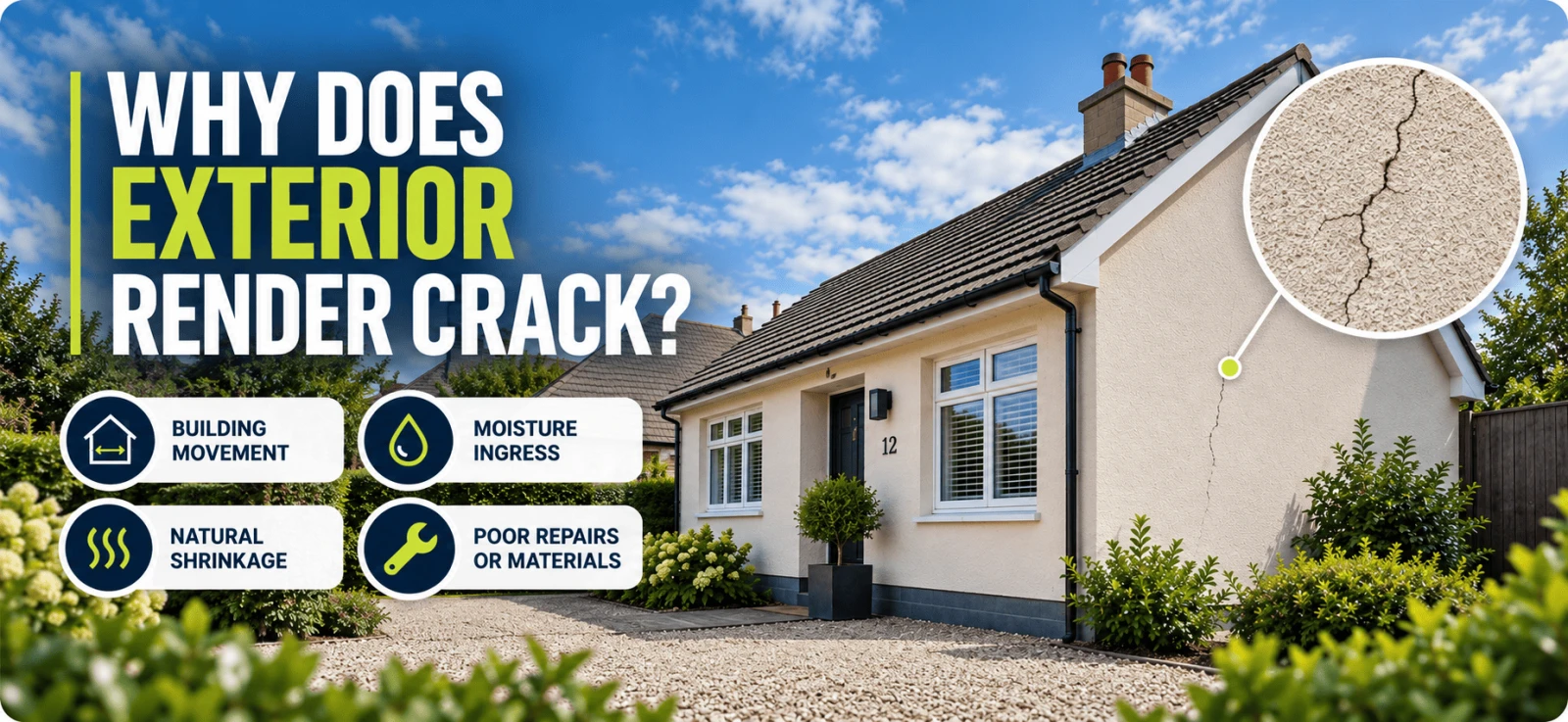
Why does exterior render crack?
More advice
Cracks in exterior render can have several causes, and the appearance of the crack alone does not always tell you which one is responsible.
Some cracks are small surface defects, while others reflect movement in the background, failed preparation, water problems or stress around openings and junctions.
The best repair starts by understanding why the crack formed, not by simply filling the visible line.
Movement in the background
Buildings move slightly over time.
Thermal changes, settlement and movement between different materials can all create stress in a relatively rigid external finish.
Cracks commonly appear near openings, at changes in background or where extensions and older parts of a building meet.
A render system can be detailed and reinforced to manage normal stresses, but it cannot compensate for significant ongoing structural movement.
Poor or failed backgrounds
Render relies on the substrate beneath it.
If old render, masonry or preparation layers are loose or unstable, the finished surface can crack or become hollow.
This is why preparation work matters so much. Applying a good product over a poor background does not remove the weakness underneath.
Water can make cracking worse
Leaks, defective gutters, overflowing downpipes and poorly sealed junctions can keep parts of a wall wetter than intended.
Repeated wetting and drying can contribute to deterioration, staining and local weakness.
Before repairing cracked render, obvious water sources should be dealt with so the new repair is not exposed to the same problem.
Temperature and exposure affect façades differently
External walls expand and contract as temperatures change.
Dark colours, strong sunlight, shaded damp walls and exposed elevations can all experience different conditions.
A south-facing elevation and a sheltered rear wall may therefore weather differently even though the same render system was used.
Correct detailing and compatible materials help the façade accommodate normal environmental stresses.
What role does reinforcement play?
Many modern systems use reinforcing mesh within a basecoat to help distribute stress and reduce the risk of cracking.
Mesh is not a cure for every movement problem, but correct reinforcement is an important part of systems such as silicone thin-coat render and external wall insulation.
The mesh needs to be properly embedded in the specified basecoat rather than simply sitting on the surface.
Can cracks be repaired locally?
Yes, in some cases.
A small isolated defect may be repairable where the surrounding render is sound. The repair needs to deal with the cause as far as possible and then be finished to match the surrounding texture.
Where cracks are widespread, repeatedly returning or associated with loose areas, a broader remedial approach may be more appropriate.
Why simply painting over cracks rarely solves them
Paint can improve appearance and weather resistance in suitable systems, but it does not make an unstable substrate sound.
If the crack is moving, a decorative coating may split again.
The same applies to filling only the surface of a deep defect. The repair has to address the actual condition of the render around it.
When should you get the crack checked?
If a crack is widening, recurring or accompanied by obvious movement in the building, it should be assessed rather than repeatedly covered.
A renderer can inspect the render system, but significant concerns about building movement may need input from an appropriately qualified building professional.
How M&M approaches render cracking
At M&M Coloured Rendering & Plastering, we look at the location, pattern and surrounding condition of the render before suggesting a repair.
We also check obvious water and detailing issues because repairing the visible crack without addressing the cause can lead to the same problem returning.
Quick answer: render can crack because of movement, weak backgrounds, poor preparation, water ingress, temperature changes or stress at junctions. Small local cracks can sometimes be repaired, but recurring or widespread cracking should be investigated before it is simply filled or painted.
Related articles
Ready to get started?
Send us a few details and we'll get back to you with a free, no-obligation quote.
 Call
 WhatsApp
 Free Quote