
Is external wall insulation (EWI) worth it?
More advice
External wall insulation can be a major home-improvement project, so it is reasonable to ask whether the benefits justify the cost and disruption.
For a suitable property, EWI can reduce heat loss through solid walls, improve comfort and provide a new protective exterior finish at the same time.
That does not mean every house should have it. The wall construction, condition, exposure, moisture behaviour, planning considerations and budget all need to be assessed first.
What does EWI actually do?
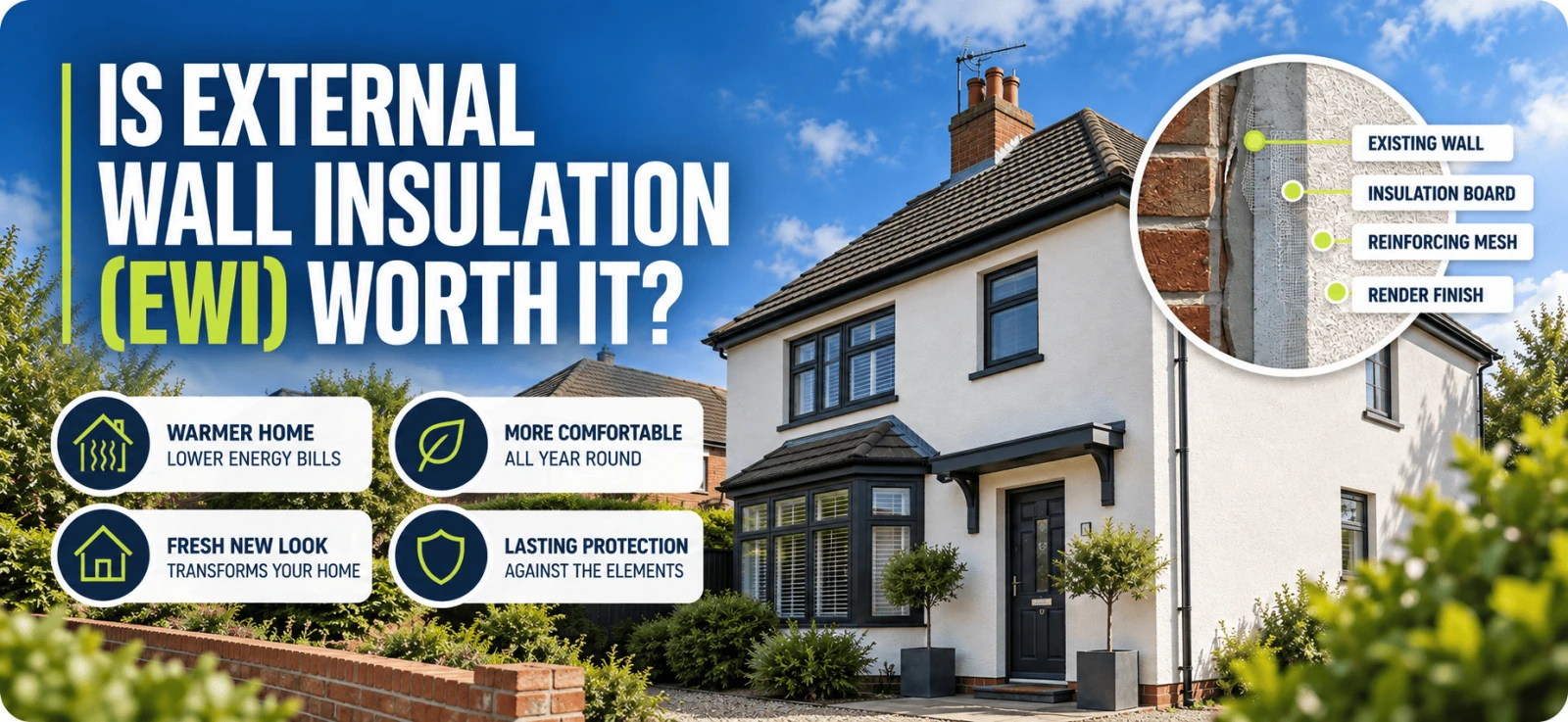
External wall insulation adds a layer of insulation to the outside face of suitable external walls.
A rendered EWI system then covers that insulation with a reinforced basecoat and protective decorative finish.
Because the insulation is outside, the internal floor area is not reduced and most of the work takes place externally.
Learn about our External Wall Insulation service →
How much difference can wall insulation make?
Walls are a significant route for heat loss in an uninsulated home.
The Energy Saving Trust says around a third of heat lost from an uninsulated home can escape through the walls.
The actual improvement in one property depends on its construction, existing insulation, heating patterns and the amount of external wall being treated.
EWI should therefore be viewed as a fabric upgrade to the building, not simply as a new render colour.
The comfort benefit can matter as much as the bill saving
Reducing heat loss can make internal wall surfaces feel warmer and can help rooms maintain temperature more evenly.
That improvement in comfort is often one of the reasons homeowners consider solid-wall insulation.
However, energy savings vary from home to home, so it is better to use property-specific advice than to assume one advertised saving will apply to every house.
EWI also changes the appearance of the property
One advantage of an external system is that the house receives a new façade finish as part of the insulation project.
That can be particularly attractive where the exterior already needs substantial refurbishment.
The colour and texture can be chosen as part of the system, but details around windows, sills, roof edges and external fittings need careful design because the wall becomes thicker.
What does EWI cost?
External wall insulation is a substantial project.
Energy Saving Trust currently gives a typical cost of around £15,000 for a three-bedroom semi-detached home as a broad national guide, while stressing that actual costs vary.
The price reflects far more than insulation boards. Scaffolding, preparation, fixings, reinforcement, render finishes and alterations around external details can all form part of the project.
If other external work is already planned, there can sometimes be efficiencies from coordinating the projects.
Moisture and ventilation must be considered
An insulation system changes the way heat and moisture move through a wall.
Existing damp, leaking gutters, damaged roofs and defective masonry should be dealt with before insulation is installed.
Energy Saving Trust guidance also emphasises appropriate materials and ventilation, particularly in older solid-wall buildings.
A suitable survey and system design are therefore essential.
When might EWI not be the right option?
EWI may be unsuitable or more difficult where access is poor, boundaries are tight, the building is exposed to severe weather or the external appearance is protected.
Listed buildings and conservation areas can require additional consideration, and planning requirements should be checked where relevant.
Some homes may be better suited to internal wall insulation or another energy-efficiency measure.
Read: External Wall Insulation vs Internal Wall Insulation →
Is EWI maintenance-free?
No external finish is completely maintenance-free.
Rendered EWI should still be inspected for local damage, staining, failed sealants and water-management issues around roofs and rainwater goods.
The benefit is that a correctly designed system protects the insulation behind it while providing the visible façade finish.
Prompt attention to small defects can help prevent them becoming larger repairs.
So, is it worth it?
For the right property, EWI can combine several benefits in one project: improved insulation, reduced heat loss, better comfort and a renewed external appearance.
Whether that is “worth it” depends on your home, budget and priorities.
At M&M Coloured Rendering & Plastering, we can explain the external installation and rendering side of an EWI project and assess whether the property appears suitable for that type of system.
Quick answer: EWI can be worth considering for suitable solid-wall homes because it improves the building fabric while renewing the exterior. It is a significant investment, so wall condition, moisture, access, detailing and expected energy benefits should all be considered before proceeding.
Related articles
Ready to get started?
Send us a few details and we'll get back to you with a free, no-obligation quote.
 Call
 WhatsApp
 Free Quote