

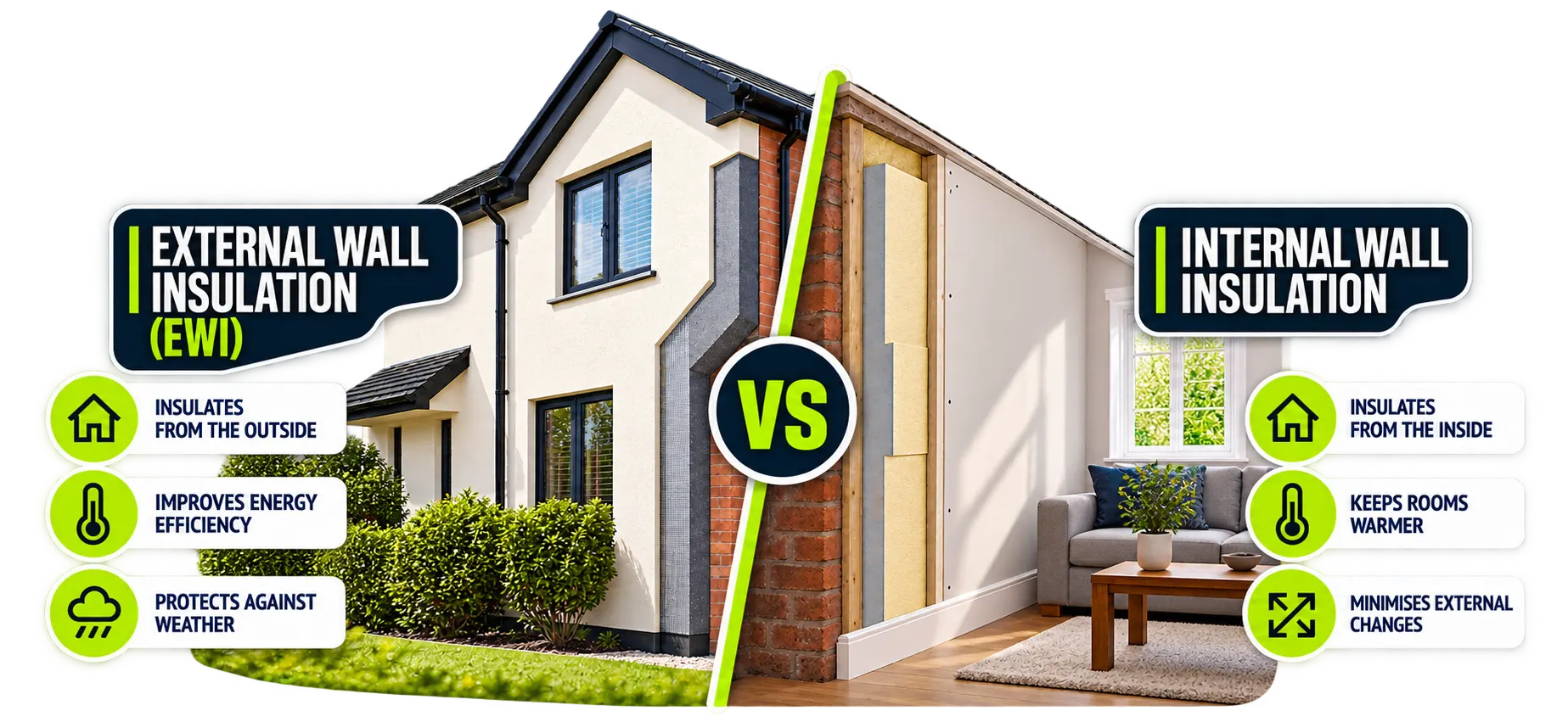
External Wall Insulation vs Internal Wall Insulation
More advice
Homes with suitable solid walls can often be insulated from either the outside or the inside. Both approaches aim to reduce heat loss, but they affect the building in very different ways.
External wall insulation (EWI) adds insulation to the outer face of the property and finishes it with a protective external system. Internal wall insulation (IWI) adds insulation to the room side of the external walls.
The right option depends on the construction and condition of the property, moisture behaviour, access, appearance, budget and how much disruption you are prepared to accept.
How external wall insulation works
A rendered EWI system typically fixes insulation to a prepared external wall and then covers it with a reinforced basecoat and protective finish.
Because the insulation is outside, the internal floor area is not reduced and most of the installation activity takes place externally.
The work does, however, affect details such as windows, sills, pipes, vents, roof edges and external fixtures. Those junctions are an important part of a properly designed system.
Learn about our External Wall Insulation service →
How internal wall insulation works
Internal wall insulation is installed to the inside face of external walls.
Depending on the system, this can involve rigid insulation boards, insulated framing or another approved build-up.
The outside appearance can remain unchanged, which can be useful on properties where the façade should not be altered.
The trade-off is that the work happens inside the rooms and reduces usable floor area to some degree.
Which option is less disruptive?
For an occupied home, EWI is often less disruptive internally because most of the work is outside.
There will still be scaffolding, noise and external access requirements, but rooms generally do not need the same level of stripping out.
IWI can involve moving furniture, altering skirting, radiators, sockets and other room details, followed by making good and redecoration.
The Energy Saving Trust highlights this difference and also notes that internal insulation is generally cheaper than external insulation for a typical property.
What happens to the appearance of the house?
EWI creates a new external finish, so it can transform the appearance of tired walls at the same time as improving insulation.
That can be a major benefit where the exterior already needs refurbishment, but it also means planning, conservation considerations and boundary details may need to be checked.
IWI generally leaves the outside appearance alone, making it potentially more suitable where external changes are restricted or undesirable.
Moisture and ventilation are critical
Insulating a solid wall changes how heat and moisture move through the building.
Existing leaks, damaged roofs, defective gutters and damp problems should be dealt with before insulation is added.
Energy Saving Trust guidance stresses the importance of suitable materials, wall condition and ventilation because poorly considered insulation can alter the moisture balance of older buildings.
This is why a system should be selected for the property rather than simply choosing the thickest insulation available.
Does EWI save more room?
Yes. EWI sits outside the property, so it does not reduce internal floor space.
IWI takes up some room area because the insulation build-up is added inside the external wall.
The amount may not sound large on paper, but it can matter in smaller rooms or where several external walls are being treated.
Which option costs more?
External wall insulation is generally more expensive because it is a full external system and often requires scaffolding, extensive detailing and alterations around external features.
Internal wall insulation is generally cheaper, but the project may still involve significant internal making good and redecoration.
Energy Saving Trust currently gives typical whole-house costs for a three-bedroom semi-detached home of roughly £15,000 for external wall insulation and £12,000 for internal wall insulation, while stressing that actual costs vary with the property.
Those figures are useful for comparison, not as a quotation for a specific home.
When does EWI make particular sense?
EWI can be attractive where the outside already needs refurbishment, where preserving internal room area is important or where homeowners want to minimise disruption inside.
It can also provide a new protective external finish when correctly designed and installed.
IWI may be preferable where altering the exterior is unsuitable, external access is limited or a room-by-room internal approach fits the wider renovation plan better.
How should you decide?
Start with the building, not the marketing claim.
The wall construction, condition, exposure, moisture behaviour, external details and household priorities should all be considered before the system is chosen.
At M&M Coloured Rendering & Plastering, our role is focused on professionally installed external wall insulation and rendered finishes. We can explain what the external work would involve and whether EWI appears suitable for the property.
Quick answer: EWI keeps the insulation outside, preserves internal floor area and can renew the exterior, but it is usually the more expensive option. IWI generally costs less and leaves the outside appearance unchanged, but reduces room space and causes more disruption indoors.
Related articles
Ready to get started?
Send us a few details and we'll get back to you with a free, no-obligation quote.
 Call
 WhatsApp
 Free Quote