

Improved Thermal Performance
Reduces heat loss through solid walls, which can meaningfully cut heating costs.
Insulation boards fixed to the outside of your property, finished with a reinforced, through-coloured render — improving thermal performance and giving your home a fresh exterior at the same time.
Improve thermal performance and refresh your exterior in one project.
Reduces heat loss through solid walls, which can meaningfully cut heating costs.

A well-installed system helps create a warmer, more even internal temperature.

The render finish goes on over the insulation, so you get a new look alongside the thermal upgrade.

Unlike internal insulation, EWI doesn’t eat into your room sizes.
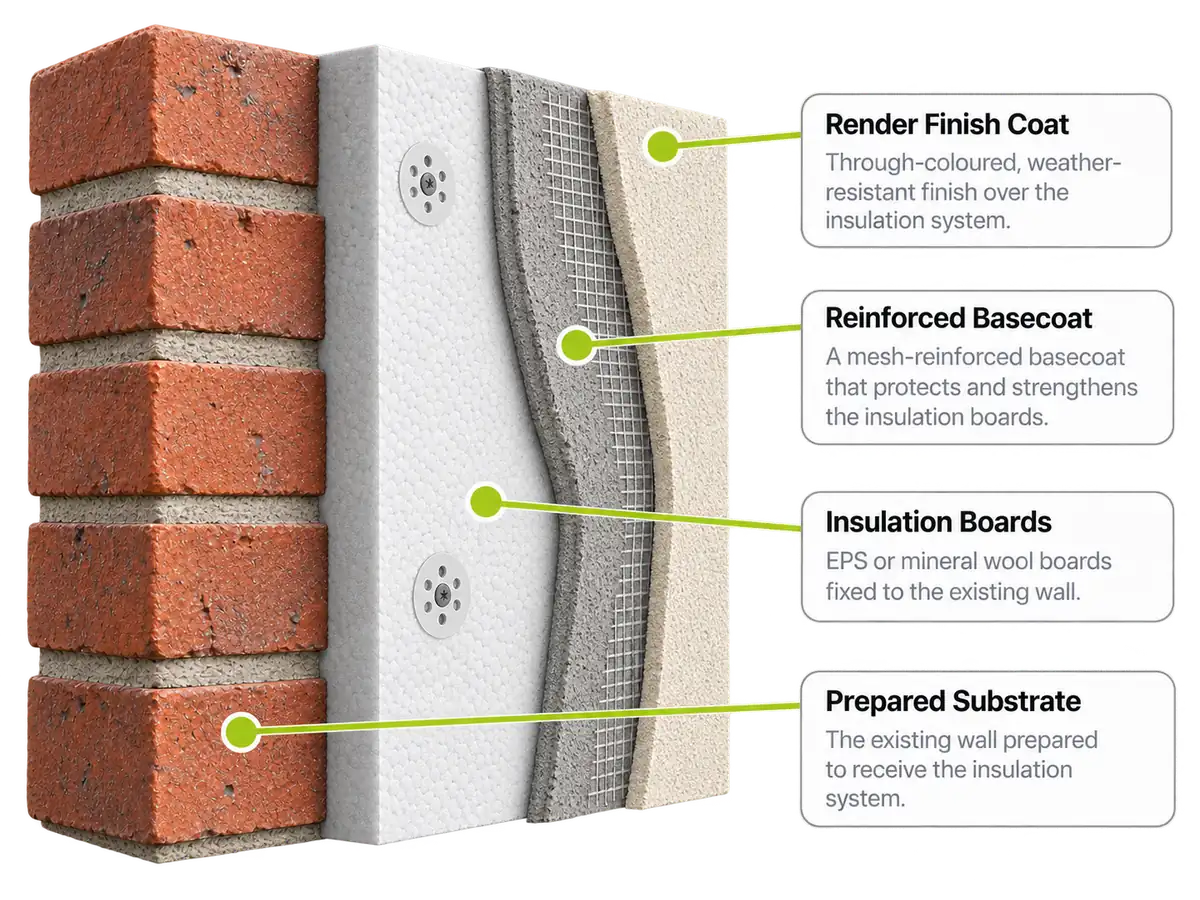
An EWI system combines an insulation layer with a reinforced, through-coloured render finish.
Reduces heat loss through the walls, particularly on older solid-wall properties.
A well-installed system reduces cold bridging.
A new render finish alongside the thermal upgrade.
Doesn’t reduce room sizes the way internal insulation can.
External wall insulation (EWI) combines an insulation layer, fixed to the outside of the property, with a reinforced, through-coloured render finish — improving thermal performance and refreshing the exterior at the same time.
Board thickness and material (commonly EPS or mineral wool) are chosen based on the thermal improvement you’re after and the wall’s existing performance.
Both give your walls a fresh exterior finish, but only one adds insulation.
Which is better? EWI is worth considering on solid-wall properties with poor existing insulation. Where insulation isn’t a priority, a standard render system may be all you need.
A proven process for a warmer, better-finished home.
We assess your walls, existing insulation and the thermal improvement you’re after.
Insulation boards are mechanically fixed and/or bonded to the wall.
A reinforced basecoat locks the boards in place and adds strength.
A through-coloured finish coat is applied and textured.
External wall insulation is particularly well suited to solid-wall properties — common in homes built before the 1930s cavity-wall era — with poor existing insulation, though it can also suit cavity-wall properties.
Board thickness is chosen based on the thermal improvement you’re after. If you’re weighing up the cost against the benefit, see our guide: is external wall insulation worth it?
EWI particularly suits solid-wall properties (common in homes built before the 1930s cavity-wall era) with poor existing insulation, though it can also suit cavity-wall properties. We assess your walls as part of a free quote.
EPS tends to offer slightly better thermal performance for a given thickness and is widely used on domestic projects. Mineral wool is non-combustible and offers better breathability and sound insulation, and is often specified where fire performance is a priority.
No — because the insulation goes on the outside of the wall, EWI doesn’t eat into your internal room sizes the way internal insulation can.
Cost depends on the wall area, board thickness and thermal improvement you’re after, access, and the render finish chosen. We provide a free quotation after assessing the property.
It depends on your property’s current insulation and how long you plan to stay. See our full guide for a balanced look at the costs and benefits.
Tell us about your property and we will assess whether EWI is the right fit and provide a clear, no-obligation quotation.


 Call
 WhatsApp
 Free Quote